Posts

Curriculum Mapping: Templates for Success & Sustainability

Image
One of the things I love most about being an art teacher is the community of people with whom I share my passion for art education. I had the amazing opportunity today to facilitate a discussion for Choice Art Educators , a special interest group of the National Art Education Association, about curriculum planning. I chose to lead a conversation on this particular topic because, of all the things we juggle as art teachers, charting a course for our students (and ourselves) is among the most challenging. There are many aspects of planning a curriculum that must be considered such as district requirements, state and national standards, content, outcomes, assessments, stakeholders, resources, and limitations to name a few. But one thing that must always be at the forefront of our thinking is our students . In the Teaching for Artistic Behavior (TAB) philosophy, the child is the artist . As long as we hold true to this tenet as we move forward (along with the others - the classroom is the ...

Inquiring Minds Want To Know

Image
At the end of class on Wednesday, a 3rd-grade artist said she had something she wanted to show me. I walked over and this is what I saw on the table. Doesn’t seem like much at first glance, right? She explained that she had been thinking about our 5-minute demo that day, where we talked about Dav Pilkey as an artist who engages and persists in his life and work. I shared a short video where he talked about his ADHD and dyslexia, and how he felt about failure. She told me, “I really liked his message about sticking with it and not giving up because I have friends who have the same disabilities. So I’m making this for them.” She explained that the paper on the left, a printmaking experiment, she wanted to turn into a sunset. She also said that she wanted to add the quote, “You got this. Do not give up.” (seen on the bottom). On the right, she showed me how she was envisioning her piece’s base by adding different bands of color with different materials (shown by the checks). She said a fe...

Bedford K-12 Art Show 2022

Image
This past weekend was our district’s art show. The care and dedication put into each piece were incredible. And I could feel the pride emanating from my artists as they saw their work on display. Just as I reflect on what makes a quality art student, I think often about what makes a quality art show. There is so much that goes into a child’s care art: highlighting the end product alone just doesn’t do the work justice. This year, the art show was structured as a learning experience for the community as well as a showcase of student achievement. (There was a poster about “Process over Product” as well, but in my mad rush to document everything I forgot to take a picture.) It’s my hope/dream that art shows everywhere will someday become primarily opportunities to showcase kids’ artistic processes rather than just celebrations of end products. I’ve seen a recent movement in that direction, especially from TAB art programs, and that makes me so grateful for the work we do. My mind is alrea...

Problem Creation

Image
What if art class wasn’t just a place to solve creative problems, but also a place to create them? One of the characteristics of 21st-century learning that educational scholars often emphasize as a vital life skill is problem-solving. But in teacher-directed, project-based art classes, students are given an artistic problem to solve by the teacher. In some instances, teachers even give away the answers to the problems when they walk the students step-by-step through how to solve them. In our TAB studio, students are first challenged to CREATE an artistic problem to solve. These problems are born from ideas, which are mined from issues of importance, from artistic skills artists want to learn more about, or from their desires to try materials or methods in new ways. Problem-creation - ideation - is no small task. The variety of problems, depth of student focus and engagement, and quality of reflection in our art studio always amaze me. I love that I work with these incredible problem-cr...

"Going Full TAB"

I’ve noticed the use of the phrase “gone/going Full TAB” popping up frequently when referring to transitioning a classroom or curriculum into one that supports choice. So I just wanted to take a moment to remind everyone that Teaching for Artistic Behavior is not a curriculum or specific way of teaching art - it is a philosophy that believes the child is the artist, the classroom is their studio, and we always ask the question ‘What do artists do?’ TAB looks different everywhere you go - it depends greatly on the students, the teacher, the space, the materials, the administration… there is no one way to “TAB.” If you believe these philosophical tenets, and center the curriculum around your students’ emergent needs, you are a TAB educator in a TAB studio. So, you can’t be “Full TAB” or “go Full TAB.” You simply ARE are TAB teacher.

The "Quality" of Child Art

Image
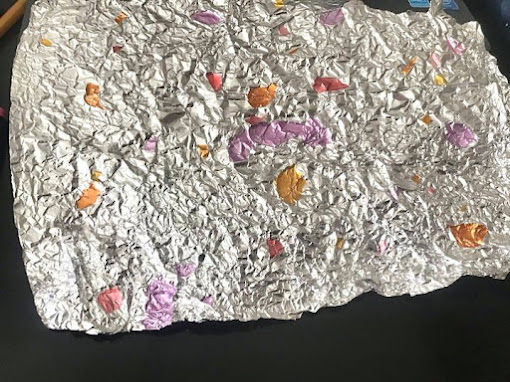
I often hear concerns about the "quality" of student artwork in TAB classrooms. Just today, a student turned in a piece (below) that I think perfectly highlights the difference in quality between "show-ready" products of project-based art rooms and the work that comes from process-based TAB rooms. Before reading beyond this paragraph, I recommend first looking closely at the photo of the student's work. Allow yourself to have an honest first opinion: what do you assume or think of it? Once you have done that, read the student's artist statement (copied and pasted below). "I made my piece “Wrinkled” because I wanted to make the piece a metaphor for what's happening to the world. My piece started out as a perfect sheet of smooth, silver foil. That’s the world before the pandemic. I crumpled the foil into a ball. That’s the world when we went into our houses and didn’t really leave. Next, I flattened it out again. That is us becoming more familiar with...

About Trace

Image
I have a group of 3 third-grade boys that love to trace on their Chromebook screens. Two weeks ago, I warned them that it would be their last week of tracing because I didn't want them relying on it like a crutch. I had it in my mind that they were "cheating" and looking for an easy way out, and I thought that taking the option to trace away would encourage them instead to develop their observation skills. I DID add some stencils to my drawing center before I visited them again, thinking that this would somehow satisfy their desire to trace and my desire to wean them off of it. The long story short is that one of the boys did not take it well at ALL. He got up shortly into the next class and left the room. One of the other boys seemed fine with the challenge, but the last one was pretty down on himself and his abilities the whole time. And then he asked me, "What's the difference between a stencil and tracing?" I knew as this whole thing was unfolding that t...